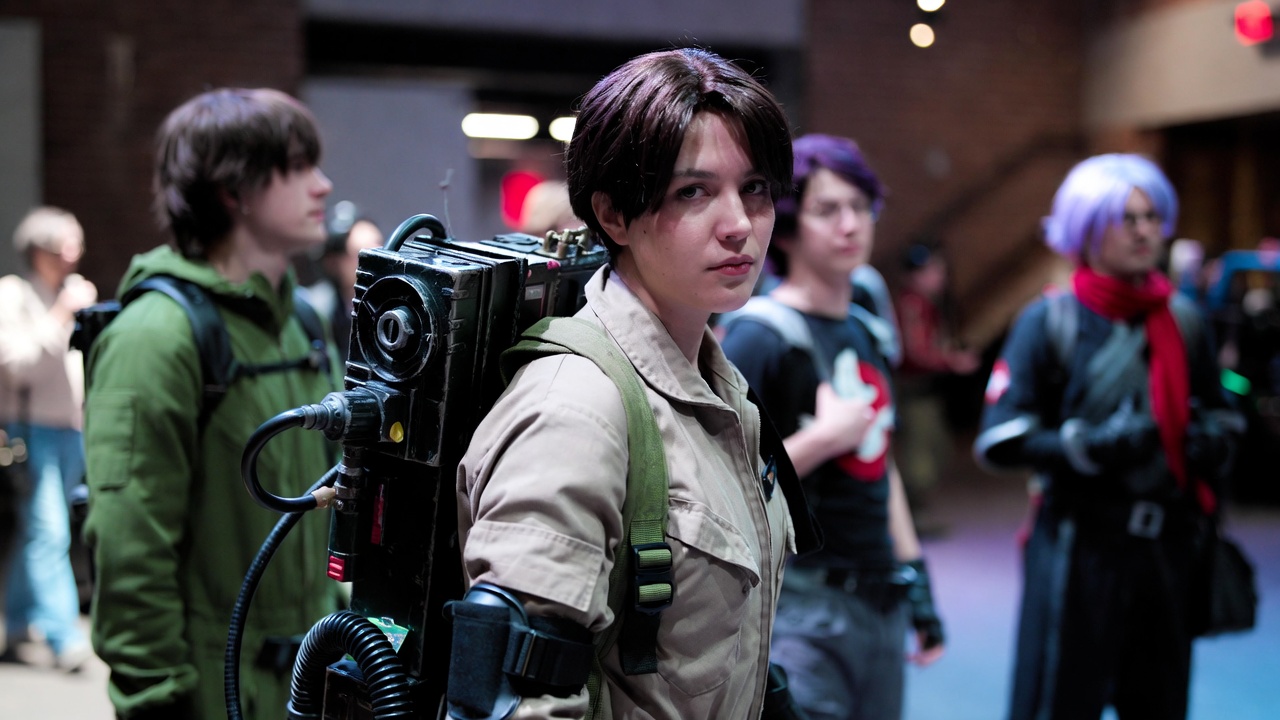
When the first trailer for the 2016 Ghostbusters reboot—colloquially known as Answer the Call—hit the internet, it didn’t just spark a cinematic debate; it ignited a localized revolution within the maker community. While critics and fans argued over the merits of reboots versus sequels, cosplayers were busy squinting at low-resolution screencaps, trying to figure out exactly what kind of hazard tape was used on the jumpsuits.
Ten years later, looking back from 2026, the 2016 reboot stands as a pivotal moment for cosplay culture. It wasn’t just about dressing up as a favorite character; it was about the democratization of the “Buster” aesthetic and a radical shift in how we approach prop building and costume design.
The Aesthetic of the “Scrap-Metal” Scientist
The primary draw for cosplayers in the 2016 film was the raw, industrial, and fundamentally “DIY” nature of the gear. In the 1984 original, the Proton Packs looked like sophisticated (if weathered) military-grade hardware. They were sleek, black, and enigmatic.
In contrast, the 2016 gear looked like it was stolen from a high school physics lab and a junkyard. This was a goldmine for creators.
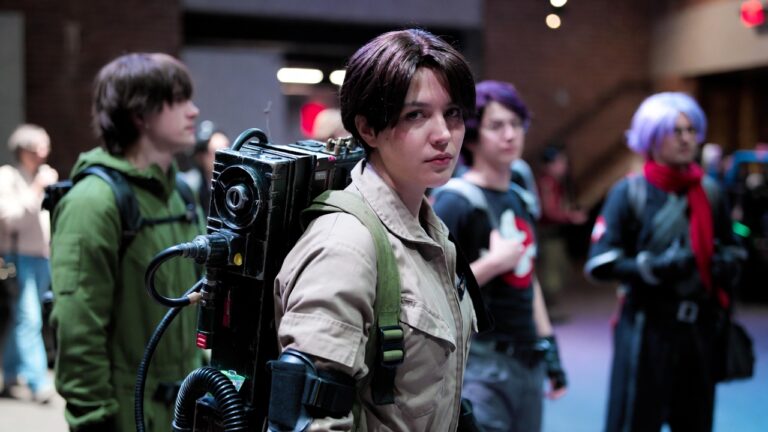
- The Proton Packs: These were no longer monolithic shells. They were a chaotic assembly of copper piping, radiator hose, and exposed wiring. For a cosplayer, this meant “found object” scavenging became the name of the game. Instead of buying expensive resin kits, makers were hitting Home Depot and eBay for vintage canisters and authentic switches.
- The Jumpsuits: Moving away from the classic tan flight suit, the 2016 crew wore heavy-duty, orange-striped coveralls that screamed “utility worker.” This change made the cosplay more accessible to various body types and genders, breaking the mold of the “standard” Ghostbuster silhouette.
- The Weapons: The introduction of the Proton Pistols, the Proton Glove, and the “Ghost Chipper” expanded the arsenal. It gave cosplayers the chance to specialize. You weren’t just “a Ghostbuster”; you were the Holtzmann of your group with a specific, hand-tuned gadget.
The “Holtzmann Effect”: A Masterclass in Character Design
If we are talking about the 2016 film through a cosplay lens, we have to talk about Jillian Holtzmann. Kate McKinnon’s character didn’t just become a fan favorite; she became a subculture.
The “Holtzmann Effect” refers to the surge in cosplayers who gravitated toward her eccentric, punk-rock scientist aesthetic. She represented a specific kind of “maker” energy that resonated deeply with the cosplay community. Her look was a mix of:
- Steampunk Influence: The yellow-tinted safety goggles and messy hair.
- Gender Fluidity: Her style played with masculine and feminine elements in a way that felt effortless and cool.
- High-Contrast Details: The paint-splattered overalls and the mismatched jewelry.
For many queer and female-identifying cosplayers, Holtzmann was a revelation. She wasn’t a “female version” of a male character; she was a unique archetype of the “mad scientist” that felt entirely her own. Even today, at conventions in 2026, you can spot a Holtzmann from across the hall by the signature yellow glow of her lenses and the swagger in her step.
Redefining the Supernatural: A Decade of Ghostbusters 2016 through the Cosplay Lens
When the first trailer for the 2016 Ghostbusters reboot—colloquially known as Answer the Call—hit the internet, it didn’t just spark a cinematic debate; it ignited a localized revolution within the maker community. While critics and fans argued over the merits of reboots versus sequels, cosplayers were busy squinting at low-resolution screencaps, trying to figure out exactly what kind of hazard tape was used on the jumpsuits.
Ten years later, looking back from 2026, the 2016 reboot stands as a pivotal moment for cosplay culture. It wasn’t just about dressing up as a favorite character; it was about the democratization of the “Buster” aesthetic and a radical shift in how we approach prop building and costume design.
The Aesthetic of the “Scrap-Metal” Scientist
The primary draw for cosplayers in the 2016 film was the raw, industrial, and fundamentally “DIY” nature of the gear. In the 1984 original, the Proton Packs looked like sophisticated (if weathered) military-grade hardware. They were sleek, black, and enigmatic.
In contrast, the 2016 gear looked like it was stolen from a high school physics lab and a junkyard. This was a goldmine for creators.
- The Proton Packs: These were no longer monolithic shells. They were a chaotic assembly of copper piping, radiator hose, and exposed wiring. For a cosplayer, this meant “found object” scavenging became the name of the game. Instead of buying expensive resin kits, makers were hitting Home Depot and eBay for vintage canisters and authentic switches.
- The Jumpsuits: Moving away from the classic tan flight suit, the 2016 crew wore heavy-duty, orange-striped coveralls that screamed “utility worker.” This change made the cosplay more accessible to various body types and genders, breaking the mold of the “standard” Ghostbuster silhouette.
- The Weapons: The introduction of the Proton Pistols, the Proton Glove, and the “Ghost Chipper” expanded the arsenal. It gave cosplayers the chance to specialize. You weren’t just “a Ghostbuster”; you were the Holtzmann of your group with a specific, hand-tuned gadget.
The “Holtzmann Effect”: A Masterclass in Character Design
If we are talking about the 2016 film through a cosplay lens, we have to talk about Jillian Holtzmann. Kate McKinnon’s character didn’t just become a fan favorite; she became a subculture.
The “Holtzmann Effect” refers to the surge in cosplayers who gravitated toward her eccentric, punk-rock scientist aesthetic. She represented a specific kind of “maker” energy that resonated deeply with the cosplay community. Her look was a mix of:
- Steampunk Influence: The yellow-tinted safety goggles and messy hair.
- Gender Fluidity: Her style played with masculine and feminine elements in a way that felt effortless and cool.
- High-Contrast Details: The paint-splattered overalls and the mismatched jewelry.
For many queer and female-identifying cosplayers, Holtzmann was a revelation. She wasn’t a “female version” of a male character; she was a unique archetype of the “mad scientist” that felt entirely her own. Even today, at conventions in 2026, you can spot a Holtzmann from across the hall by the signature yellow glow of her lenses and the swagger in her step.
Technical Challenges: Building the 2016 Gear
From a technical standpoint, replicating the 2016 gear was actually more difficult than the 1984 versions. In the original films, the Proton Pack has a “hero” configuration that is well-documented. In the 2016 film, the equipment evolves.
Cosplayers had to track the “Mk I” pack through to the final “Mk III” versions used in the climax. This required a level of forensic observation that pushed the community to share resources more than ever before. We saw the rise of specialized forums and Discord servers dedicated solely to “reboot builds.”
“The 2016 pack is a nightmare of plumbing. You think you’ve found the right copper elbow joint, and then you realize the film prop used a custom-machined piece of PVC painted to look like aged brass. It forces you to be a better painter and a better engineer.” — Anonymous Pro-Maker, 2017
The lighting kits also became more complex. The 2016 packs featured a “spinning” circular light effect in the cyclotron that was different from the sequential blinking of the ’84 packs. This led to a surge in Arduino and Raspberry Pi integration within the community, as makers programmed custom LED patterns to match the cinematic “warm-up” sequences.
The Cultural Impact: Visibility and Inclusivity
Perhaps the most significant legacy of the 2016 reboot in the cosplay world is the door it kicked open for inclusivity. Before this film, women in the Ghostbusters costuming community (like the 501st Legion equivalent, the Ghost Corps) often felt like they were playing “alternate universe” versions of the guys.
The 2016 film gave them their own canon. It gave them a seat at the table that wasn’t “Pink Ghostbuster” or “Janine in a suit.” It was legitimate, frontline paranormal investigation.
This shift had a ripple effect:
- The Rise of Local Franchises: We saw an explosion of new “Franchises” (cosplay groups) that were entirely female-led or gender-diverse.
- Body Positivity: The character of Abby Yates (Melissa McCarthy) provided a blueprint for cosplayers who didn’t fit the “action hero” physique but still wanted to look like they could kick a ghost’s butt.
- The Intersection of Fandoms: The reboot bridged the gap between the “Hard Sci-Fi” builders and the “Fashion” cosplayers. You needed the technical skills to build the pack, but you needed the “thrift store hunt” skills to find the perfect Patty Tolan earrings or Erin Gilbert sweater vests.
The Evolution of Materials
By the time the 2016 reboot reached its five-year anniversary, the way we built these costumes had fundamentally changed thanks to advancements in 3D printing. In the early days of the reboot, you had to be a master of “found object” construction.
By 2021, and certainly now in 2026, almost every component of the 2016 Proton Pack has been digitally modeled and made available for free or purchase. This has changed the “cosplay lens” from one of scarcity (finding that one specific vintage part) to one of refinement (printing, sanding, and weathering that part to perfection).
Interestingly, the 2016 aesthetic actually looks better when 3D printed than the 1984 gear. The “layered” look of the reboot props hides print lines better and allows for more interesting textures. The “Rough-and-Tumble” look means that if your print has a slight flaw, you don’t throw it away—you turn it into “battle damage.”
Comparative Analysis: ’84 vs. ’16 in the Workshop
When a cosplayer decides to build a Ghostbusters kit, they are faced with a choice of philosophy.
| Feature | 1984 Classic | 2016 Reboot |
| Primary Material | Fiberglass / Resin | Metal / Industrial Salvage |
| Vibe | “Government Surplus” | “Basement Lab” |
| Color Palette | Matte Black / Red / Blue | Copper / Silver / Safety Orange |
| Complexity | High (Internal Wiring) | Extreme (External Plumbing) |
| Costume | Uniform / Cohesive | Individualized / Eclectic |
The 1984 suit is about being part of a team. The 2016 suit is about expressing a personality. Through the cosplay lens, the 2016 film is a “character study” in kit-bashing.
Legacy: The “Answer the Call” Community Today
While the film itself remains a point of contention for some movie buffs, the cosplay community has largely moved past the “culture war” aspect. In 2026, we see a beautiful synthesis. It is now common to see “Hybrid” franchises at conventions—groups where two members wear the ’84 khaki and two wear the ’16 stripes.
The gear has also cross-pollinated. You’ll see “classic” packs modified with the 2016-style heat sinks, or 2016 jumpsuits tailored with the classic “No-Ghost” patch on the right arm instead of the left.
The 2016 reboot taught the cosplay community that the Ghostbusters mythos is flexible. It proved that the “tools and the talent” don’t belong to just one group of people or one specific aesthetic. It turned the Proton Pack into a canvas for individual creativity.
Final Thoughts on the Maker Spirit
If you walk into a workshop today and see someone soldering a mess of wires into a copper pipe while wearing a pair of yellow-tinted goggles, you are seeing the direct lineage of the 2016 reboot. It validated the “messy” side of science. It celebrated the tinkerer, the hoarder of spare parts, and the person who isn’t afraid to get a little radioactive grease on their jumpsuit.
The 2016 Ghostbusters may have been a reboot of a film, but for the cosplay world, it was an upgrade of the soul. It reminded us that being a Ghostbuster isn’t about looking like a movie star; it’s about looking like you just built something impossible in your garage—and you’re ready to use it.
Whether you prefer the ribbon cables of the past or the copper pipes of the reboot, one thing is certain: the “cosplay lens” has never been clearer, and the ghosts don’t stand a chance.
About the Author