Long before the word “cosplay” existed, American science fiction fans were stitching together the first chapter of a worldwide phenomenon.
An in-depth look at the 1939 Worldcon and the cultural movement it sparked
On a warm summer evening in New York City in 1939, two young science fiction enthusiasts walked into the first World Science Fiction Convention wearing costumes inspired by a futuristic short story. Their names were Forrest J. Ackerman and Myrtle R. Douglas, and what they did that night was far more consequential than either of them could have imagined. They were not performing in a play, they were not attending a theater event, and they were not earning a prize. They were simply fans who loved a fictional world so much that they wanted to inhabit it, if only for one evening. That impulse became the seed of a global cultural movement that would eventually be known as cosplay.
To understand the Western roots of fan costuming, one must first understand the world that produced it. The 1930s were a golden age of science fiction literature in America. Pulp magazines like Amazing Stories, Astounding Science Fiction, and Thrilling Wonder Stories were flying off newsstands. The readers of these publications were not passive consumers. They wrote letters to editors, debated alien civilizations with strangers through the mail, and formed clubs dedicated to discussing imaginary futures. They called themselves “fans,” and they were intensely proud of it. This was a community that took fiction seriously, not as escapism but as a genuine intellectual and emotional engagement with the possibilities of the universe.
They were simply fans who loved a fictional world so much that they wanted to inhabit it, if only for one evening.
It was from this community that the idea of a convention emerged. In 1939, a small group of enthusiasts organized the first World Science Fiction Convention, known today as Worldcon, in New York City. Approximately 200 people attended. By the standards of modern conventions, which attract tens of thousands of visitors, this was a modest gathering. But by the standards of 1939, when the idea of fans traveling from across the country to celebrate a literary genre was almost unheard of, it was extraordinary. Worldcon was not just a meeting. It was a declaration that fans of speculative fiction deserved a space of their own.
Ackerman and Douglas: The First Cosplayers
Forrest J. Ackerman arrived at the 1939 Worldcon wearing a costume he called “futuristic,” inspired by the visual aesthetic of the science fiction stories he adored. Myrtle R. Douglas, known in fan circles as “Morojo,” accompanied him in a similarly themed outfit. The costumes were not elaborate by modern standards. They were handmade, reflecting the resources and imagination of two dedicated fans rather than a professional costume department. But they were entirely intentional. Ackerman and Douglas wanted to physically embody the spirit of the genre they loved. Their decision to dress up was a creative act and also a communal one. They were inviting others to see the worlds of science fiction not just on the page, but in the flesh.
The reaction from other attendees was mixed. Some found the costumes delightful and inspired. Others were puzzled or even skeptical. But the photographs taken that day survived, and they tell a story of something genuinely new being born. Here were real people choosing to cross the boundary between reader and character, between audience and story. That act of boundary crossing is precisely what would define cosplay decades later, even when the name and the scale were entirely different.
The Convention Culture That Followed
After 1939, the tradition of wearing costumes to science fiction conventions grew slowly but steadily. Worldcon became an annual event, rotating between cities across the United States and eventually around the world. Each year, a small but growing number of attendees chose to arrive in costume. By the 1950s, the practice was common enough that some conventions began organizing formal masquerades, which were competitions where fans could present and be judged on their costumes. These masquerades became beloved institutions within the science fiction fan community and introduced a new level of craft and ambition to fan costuming.
The masquerades were significant for several reasons. They gave fans a structured occasion to invest serious time and skill in their costumes. They created a social context in which wearing a costume was not merely permitted but actively celebrated. And they established a vocabulary of appreciation that recognized costume making as an art form in its own right, separate from the literature that inspired it. A fan who built an intricate suit of armor modeled on a character from a pulp novel was doing something that deserved recognition, and the masquerade format provided exactly that.
Key moments in early fan costuming
- 1939Forrest J. Ackerman and Myrtle Douglas attend the first Worldcon in New York in handmade “futuristic” costumes.
- 1940sCostume wearing at Worldcon grows steadily; the tradition earns informal recognition from the fan community.
- 1950sFormal masquerade competitions are introduced at several conventions, elevating costuming to a recognized craft.
- 1960sStar Trek fan communities emerge, expanding the range of characters being portrayed beyond print literature.
- 1970sStar Wars and other blockbuster franchises bring a new generation of fans into costuming culture.
- 1984Japanese journalist Nobuyuki Takahashi attends Worldcon in Los Angeles, coins the term “cosplay,” and brings the concept to Japan.
Television, Film, and a Changing Canvas
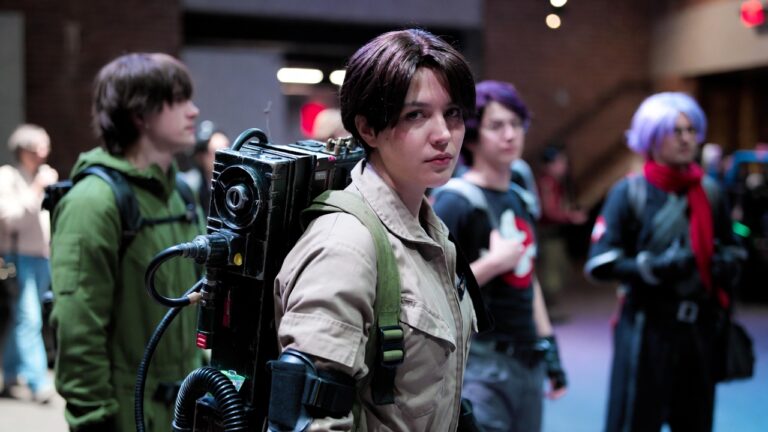
Through the 1960s and 1970s, the scope of fan costuming expanded significantly. Science fiction was no longer confined to pulp magazines and paperback novels. Television had brought characters into living rooms across America, and film was creating icons that transcended the page entirely. The premiere of Star Trek in 1966 gave rise to one of the most dedicated fan communities in history. Trekkies, as they came to be known, embraced costuming with particular enthusiasm. Characters like Captain Kirk, Spock, and Lieutenant Uhura were recognizable figures with distinctive uniforms, and fans began recreating those uniforms with remarkable fidelity.
Then came Star Wars in 1977. The cultural impact of George Lucas’s film was so enormous and so immediate that it reshaped the landscape of fan costuming almost overnight. Suddenly there were Darth Vaders and Stormtroopers and Princess Leias at conventions across the country. The visual language of the film was so vivid and so iconic that it inspired fans to invest in costumes of a complexity and quality that had rarely been attempted before. The 501st Legion, a worldwide organization of Star Wars costume enthusiasts, would eventually grow from this tradition, but even in the late 1970s, the scale of Star Wars costuming was something new.
The Craft and Community Behind the Costume
What made Western fan costuming more than a novelty was the community that formed around it. Fans did not merely wear costumes. They discussed construction techniques, shared patterns, traded materials, and mentored newcomers. Before the internet existed, this exchange happened through fanzines, club newsletters, and the conventions themselves. A skilled costumer might spend months preparing a single outfit, researching historical details, experimenting with unfamiliar fabrics, and solving the practical problems of building something wearable that also looked believable. The knowledge accumulated through this process was substantial, and fans took pride in sharing it.
This community dimension was crucial. Fan costuming was never simply about individual expression, though it was certainly that too. It was about belonging to a group of people who understood why a well-made costume mattered and who would appreciate the hours of work hidden inside a finished piece. The conventions provided a physical space where that appreciation could be expressed directly. Walking into a masquerade and seeing other fans respond to your work with recognition and admiration was a powerful experience, and it kept people coming back year after year with increasingly ambitious projects.
The Bridge to Japan and the Birth of a Global Tradition
In 1984, a Japanese journalist and science fiction enthusiast named Nobuyuki Takahashi attended Worldcon in Los Angeles. He was struck by the costumed fans he saw and wrote about the experience for a Japanese publication, coining the term “cosplay” as a portmanteau of “costume” and “play.” When that concept landed in Japan, it found a culture already primed to receive it. Manga and anime had created a rich ecosystem of visually distinctive characters, and events like Comiket were already bringing fans together in large numbers. The word “cosplay” gave a name and an identity to something that was beginning to happen naturally in Japan, and from there it spread with astonishing speed.
The irony is that the practice Takahashi was describing had originated in the very Western fan culture he was visiting. The American science fiction community had been doing this for 45 years before the word cosplay existed. What Japan contributed was not the practice itself but a rebranding and an intensification. Japanese cosplay culture brought new levels of craftsmanship, new organizational structures, and eventually a global platform that carried the tradition back to the West in a transformed and expanded form.
A Living Legacy
Today, fan costuming touches virtually every corner of popular culture. Conventions like San Diego Comic-Con attract hundreds of thousands of visitors each year, and costumed attendees are among their most visible and celebrated participants. Professional cosplayers earn livings through their craft. Online communities have made it possible for fans from every country to share techniques, find inspiration, and celebrate each other’s work. The masquerades that began at small science fiction gatherings in mid-century America have evolved into international competitions with serious prize money and media coverage.
None of this would exist without the people who came before. When Forrest J. Ackerman and Myrtle Douglas walked into that 1939 convention in their handmade costumes, they were doing something that had no name and no tradition behind it. They were acting on pure love of a genre and a community. The fact that their small, improvised act would eventually connect to a global movement is not something they could have foreseen. But it is something worth remembering, because it reminds us that the most enduring cultural traditions often begin not with grand plans or institutional support, but with a few people simply choosing to show up and be fully, enthusiastically, themselves.
About the Author