The 1970s marked the first major shift in how Japanese youth consumed media. It was the decade of the “Galaxy Express 999” and “Space Battleship Yamato,” series that introduced complex narratives and iconic character designs. Unlike the simpler cartoons of the past, these shows featured characters with distinct, stylized aesthetics—uniforms, capes, and mechanical details—that begged to be replicated in the physical world.
This period also saw the rise of the shojo (girls’) manga revolution led by the “Year 24 Group.” Artists like Riyoko Ikeda, creator of “The Rose of Versailles,” introduced an intricate, flamboyant style of dress inspired by historical European fashion. The visual density of these characters provided the first real challenge and inspiration for early cosplayers. When fans saw Lady Oscar in her glittering military regalia, the desire to inhabit that character went beyond mere reading; it became a performative aspiration.
The 1980s: The Rise of the Otaku and the Birth of “Cosplay”
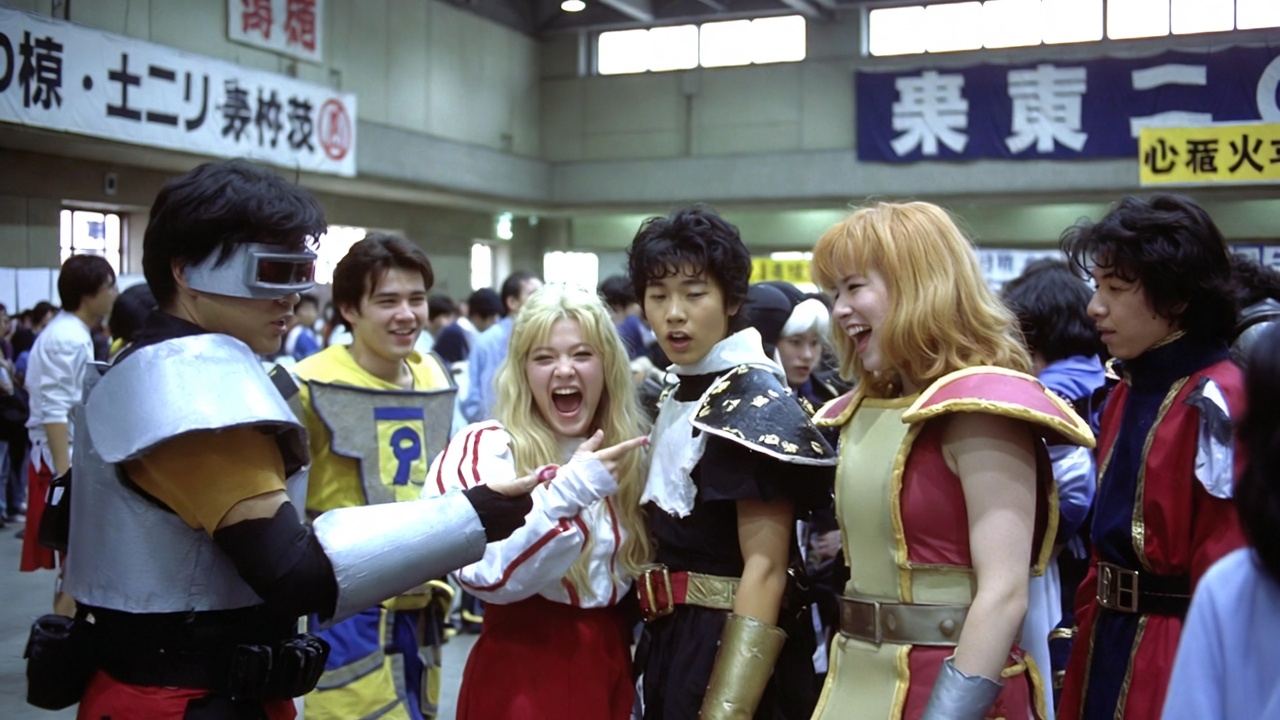
While people had been dressing as characters at science fiction conventions in the US since the 1930s, the term “cosplay” (a portmanteau of costume and play) was famously coined by Nobuyuki Takahashi of Studio Hard in 1984. After attending Worldcon in Los Angeles, Takahashi was struck by the fans in costume but found the English word “masquerade” too old-fashioned and “costume” too static. He wanted a term that captured the Japanese spirit of asobi (play).
The 1980s were defined by the “Otaku” surge. This was the era of “Mobile Suit Gundam” and “Macross.” The complexity of the designs increased, and with it, the dedication of the fans. It wasn’t enough to just wear a mask; fans began experimenting with materials like cardboard, vinyl, and early plastics to recreate mecha armor and futuristic jumpsuits.
The Evolution of Character Design
Character designers like Yoshitaka Amano and Mamoru Oshii began pushing the boundaries of what was visually possible. The “moe” aesthetic also began to take root, where character traits were designed specifically to evoke an emotional response. This made the characters more “attachable,” leading fans to want to express their loyalty through physical transformation.
Comiket: The Heart of the Movement
No discussion of the rise of cosplay is complete without mentioning Comiket (Comic Market). Founded in 1975 as a small experimental gathering for dōjinshi (self-published works), Comiket grew exponentially through the 80s and 90s.
By the late 80s, Comiket had become the ultimate “hub.” It was a space where the barriers between creator and consumer vanished. Because it was a fan-run event, there was no corporate oversight telling people what they could or couldn’t wear. This freedom allowed for a rapid evolution of techniques. Cosplayers would gather in designated areas, often referred to as “cosplay squares,” to be photographed by amateur and professional photographers alike.
Comiket served several vital functions for the burgeoning industry:
- Validation: Seeing hundreds of others in costume normalized the hobby.
- Resource Exchange: Fans would trade tips on how to style wigs or where to find specific fabrics.
- Media Exposure: Magazines started dedicated columns to Comiket cosplay, turning local fans into “cosplay idols.”
The 1990s: The Golden Age and Global Sprawl
If the 70s were the foundation and the 80s the birth, the 1990s were the explosion. This decade saw the release of “Neon Genesis Evangelion,” “Sailor Moon,” and “Dragon Ball Z.” These titles did more than just dominate Japanese television; they became the vanguard of “Cool Japan” on a global scale.
The Sailor Moon Effect
“Sailor Moon” was a pivotal moment for cosplay. The “Sentai” (team) nature of the show encouraged group cosplay, which strengthened the social aspect of the hobby. The designs were colorful, distinct, and—most importantly—reproducible. This led to a massive influx of female fans into the cosplay scene, many of whom brought sewing skills and fashion sensibilities that elevated the quality of costumes across the board.
Evangelion and the Professionalization of Craft
Conversely, “Neon Genesis Evangelion” introduced the “plugsuit”—a sleek, futuristic aesthetic that required the use of spandex, latex, and molded plastics. This pushed cosplayers toward industrial design and prop-making. Suddenly, a “good” cosplay wasn’t just a dress; it was an engineered suit. The 90s also saw the rise of specialized cosplay shops like Cospa, which began selling officially licensed costumes, indicating that the hobby had reached a level of commercial viability that could support a retail market.
The Cultural Impact: Why Japan?
Why did this happen in Japan specifically during this window? Several socioeconomic factors converged to create this “perfect environment.”
- The Urban Infrastructure: Japan’s dense urban centers and efficient train systems made it easy for fans to congregate at major venues like the Tokyo Big Sight.
- A Culture of Craftsmanship: Japan has a long history of monozukuri (the art of making things). This traditional respect for craftsmanship translated easily into the meticulous creation of costumes.
- The Concept of “Henshin”: The idea of “transformation” (henshin) is deeply embedded in Japanese pop culture, from Kabuki theater to Tokusatsu shows like “Kamen Rider.” Cosplay was a modern, secular way to engage with the ancient human desire to become something more than oneself.
The Role of Magazines and Media
Before the internet became the primary source of information, magazines like Cosmode and Monthly Afternoon played a crucial role. They published patterns, makeup tutorials, and reports from events like Comiket. These publications acted as the “social media” of the 90s, allowing a cosplayer in rural Hokkaido to see what the trendsetters in Harajuku were wearing.
This created a feedback loop: the media covered the cosplayers, which made the hobby look attractive to newcomers, who then created even better costumes, which led to more media coverage. By the mid-90s, cosplay had moved from the fringes of “weird” subculture into a recognized pillar of the Japanese tourism and entertainment industries.
Legacy and the Digital Transition
As the 90s came to a close, the rise of the digital camera and the early internet transformed cosplay again. Photos could now be shared instantly on forums and personal websites. The “hubs” like Comiket remained physically important, but the “perfect environment” had expanded into the digital realm.
Today, when we see cosplayers at massive conventions like Anime Expo in Los Angeles or gamescom in Germany, we are seeing the direct descendants of the fans who roamed the halls of Japanese hotels and convention centers in the 70s and 80s. The manga and anime industry didn’t just provide the characters; it provided a philosophy of fandom that prioritized participation over passive consumption.
Japan’s thriving industry during this golden era proved that a character doesn’t end at the final page of a manga or the closing credits of an episode. Through cosplay, the fans became the living extensions of the art they loved, ensuring that the vibrant culture of the 1970s–90s would continue to walk the streets of the real world for decades to come.
“Cosplay is not just about the costume; it is about the bridge between the 2D world of imagination and the 3D world of reality. In that space, the fan becomes the creator.”
About the Author