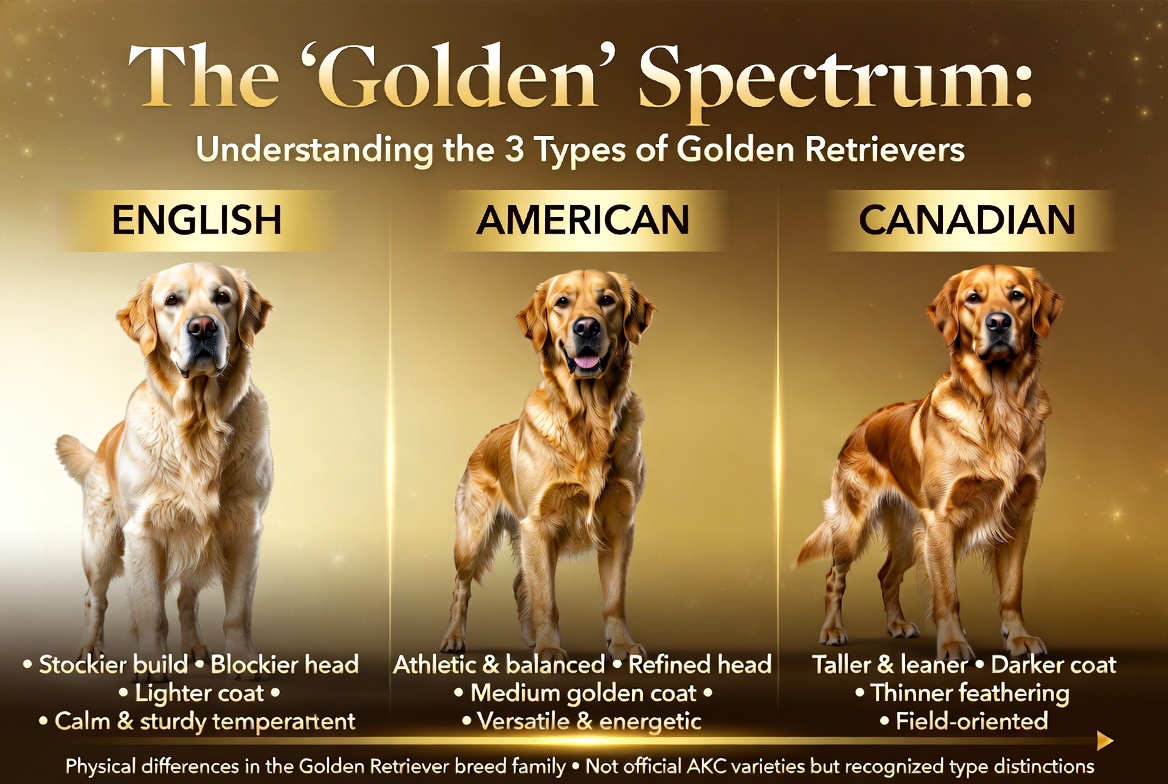
When most people picture a Golden Retriever, they envision a friendly, energetic dog with a shimmering coat of amber fur. However, within the breed community and among professional enthusiasts, there is a fascinating level of nuance that goes beyond a single look. While the American Kennel Club and other international registries technically recognize the Golden Retriever as one singular breed, there are three distinct subtypes that have emerged through decades of regional breeding standards: the American, the English Cream (British), and the Canadian Golden Retriever.
Understanding these differences is more than just an exercise in aesthetics. For a prospective owner or a dedicated fan of the breed, recognizing the “Golden Spectrum” helps in understanding the history, the subtle temperament shifts, and the physical requirements of the dog that will eventually become a member of the family.
The Origins of a Global Icon
To understand why these three branches exists, one must look back to the mist-covered highlands of late 19th-century Scotland. The breed was founded by Dudley Marjoribanks, also known as Lord Tweedmouth. He sought to create a premier hunting dog capable of retrieving waterfowl from both land and water in the rugged Scottish climate. By crossing a “Yellow Retriever” with the now-extinct Tweed Water Spaniel, and later introducing Bloodhound and Irish Setter genetics, the foundation for the Golden Retriever was laid.
As these dogs were exported from the United Kingdom to North America and beyond, regional preferences began to shape their evolution. Breeders in the United States prioritized certain traits for the local hunting terrain and show ring, while Canadian breeders adapted the dogs to their vast, often colder landscapes. This geographical separation is what eventually gave us the three “types” we celebrate today.
The American Golden Retriever: The Classic Athlete
The American Golden Retriever is perhaps the most recognizable version of the breed in the Western world. When you see a Golden starring in a Hollywood movie or a television commercial, it is almost certainly the American subtype.
Physical Characteristics The American variety is typically leaner and taller than its British cousin. They are built for agility and endurance, possessing a rangier frame that suggests an athletic capability. Their coat is one of their most defining features; it is usually a rich, vibrant gold, ranging from a medium-toned amber to a deep, burnished copper. The fur is generally thinner and less “fluffy” than other types, lying flatter against the body to prevent snagging on brush during a hunt.
The head of an American Golden is more “wedge-shaped” or triangular. Their eyes are almond-shaped and sit higher on the face, giving them an alert, keen expression. One subtle but distinct marker is the set of the ears; in American lines, the ears sit higher on the head, trailing just above the eye line.
Temperament and Energy Because many American lines were bred with a focus on field trials and active work, these dogs often possess a slightly higher energy drive. They are the quintessential “velcro dogs,” intensely devoted to their owners and always ready for a game of fetch. While all Goldens are friendly, the American line is often noted for its high-spirited enthusiasm.
The English Cream (British) Golden Retriever: The Gentle Aristocrat
In recent years, the “English Cream” has skyrocketed in popularity. While the term “English Cream” is often a marketing label used by breeders, it refers to the British style of Golden Retriever that adheres to the standards of the United Kennel Club in the UK.
The Pale Aesthetic The most striking difference is the color. British Goldens are frequently much lighter than their American counterparts, with coats ranging from a very pale lemon to a creamy white. It is important to note that a “white” Golden Retriever is still a Golden; they simply sit at the lightest end of the pigment spectrum.
A Sturdier Build Physically, the British type is heavier and more “blocky.” They have a broader skull, a deeper chest, and shorter legs, giving them a more powerful, sturdy appearance. Their coat is often thicker and more prone to “feathering” around the legs and tail.
Perhaps the most charming feature of the English type is the face. Their eyes are rounder and darker, and they sit level with the ears. This combination creates the famous “smiling” expression that the breed is known for. Many owners find the British type to have a more soulful, calm gaze compared to the high-alert look of the American line.
A Mellow Disposition While individual personality always varies, British lines are often cited as being slightly more mellow or “chill.” They are still active dogs, but they are frequently described as having a more “off switch” when indoors, making them excellent candidates for therapy work or for families who prefer a more relaxed companion.
The Canadian Golden Retriever: The Rugged Northman
The Canadian Golden Retriever is the least discussed of the three, yet it is a distinct and impressive animal. This subtype evolved to handle the vast and varied terrain of Canada, from thick forests to icy waters.
The Standout Silhouette The Canadian Golden is often the tallest of the three types. They have a very athletic build, but unlike the American line, they often lack the heavy “feathering” of fur on the back of the legs and neck. This gives them a sleeker, more streamlined appearance.
Their coat color is often a middle ground; it is usually darker than the English Cream but can be slightly more varied than the American gold. However, the density of the coat is remarkable. Canadian Goldens often have a very thick, short, and extremely water-repellent double coat designed to keep them warm in sub-zero temperatures.
The Working Mind In terms of personality, the Canadian type is often highly focused. Because they have remained closer to their working-dog roots in many regions, they possess an incredible work ethic. They are highly intelligent and require significant mental stimulation to stay happy.
Comparing the Three: A Quick Reference
| Feature | American Golden | English Cream (British) | Canadian Golden |
| Coat Color | Dark Gold to Mahogany | Cream to Light Gold | Medium Gold to Dark |
| Body Build | Slender and Athletic | Heavy, Broad, and Stocky | Tall and Lean |
| Head Shape | Wedge-shaped | Broad and Blocky | Broad with Fine Features |
| Eye Shape | Almond-shaped | Round and Dark | Large and Soulful |
| Energy Level | High / Very Active | Moderate / Mellow | High / Work-focused |
About the Author